
Episode 56
In This Episode
What happens when you sit down with an old friend who happens to be one hell of a guitar player? You get some pretty damn good rock 'n' roll stories!
This week on I'm Leaving Right After This Drink, I'm joined by guitarist Gary Hoey, a guy I've known for nearly 30 years.
We go all the way back to Gary's early days, his first guitar, and the incredible story of how he ended up auditioning for Ozzy Osbourne. We also get into his career, working with artists like Lita Ford and Lou Gramm, playing music with his son Ian, and some of the people and experiences that shaped him along the way.
Gary also shares some personal stories about his mom, his family, and what music has meant to him over the years.
This isn't your typical interview. It's two old friends catching up, talking guitars, rock 'n' roll, and a few things I hadn't even heard before!
Grab a drink, kick back, and enjoy my conversation with Gary Hoey.
Cheers, my friends! 🤘🥃
Read the full transcript
Tits McGee: So Bryan has Gary Hoey on the podcast today, a world-class guitarist, an incredible musician, and apparently a guy with absolutely no idea what he's getting himself into. Somebody get Gary a whiskey. And now here's Bryan and Gary Hoey. Cheers, my friends.
Bryan: Welcome, welcome to another episode. And I have to tell you guys, I am super excited about today. And I've been thinking about this a lot, because joining me, as we finally got schedules all aligned, is Mr. Gary Hoey.
And you know, Gary, I've been thinking about this, man. Me and you have been friends now for almost 30 years. I was thinking back to when you used to stop by my internet radio station when we were both living in Los Angeles. That's when I first met you, and you came down with your band in the box, and I got the one-man personal concert in the studio, which was always phenomenal.
And Gary's a guy, for those of you who may or may not know... I can't believe you would not know who Gary was if you've been in the rock and roll business at all, because Gary's been around for decades at this point. He's had a successful career. And so, like I said, Gary, I'm excited that you're joining me today, and I just kind of want to talk a little bit about everything and what's going on. But I think the very first question, which I think is the most important question to ask today, is: how many guitars do you have?
Gary: Wow, my bro. I probably have close to 40 at this point. They're all over the studio, hanging all over the walls, and I've got a corral full of them. I've got my blue one hanging here, my green Peace guitar back here, with the panda bear on it. I think you and I hung out with that guitar a few times.
And my old Les Pauls, and just lots of acoustics. Yeah, I'm getting close to 40. Of course, my son Ian, I don't want to say stole, but about 10 of them are now in his bedroom.
Bryan: Well, the good news is I'm still under you in my guitar collection. So I am at 34, about to get 35, but at least I'm not ahead of a touring musician, because that would just be bad.
Gary: Well, that's quite a bit that you have there. That's amazing. I saw your post about the Tony Iommi record and you were showing your SG. I thought that was so cool. You had a Tony Iommi signature model. I thought that was a great guitar, man.
Bryan: I absolutely love that guitar. And like I mentioned in that episode, I ended up getting that from a family member who passed away, and it turns out that he had an incredible collection of guitars that nobody really knew he had. They thought he had like a dozen, and it turned out he had like 40 or 45 guitars.
He had this incredible collection that had the Tony Iommi, he had a Dick Dale 50th anniversary guitar in there, he had tons of stuff, he had some Les Pauls. It was an incredible collection, and I was fortunate enough to get my hands on that Tony Iommi and another custom SG that he had. So yeah, man, it's very cool.
Gary: Hey, it's good to know that they're in good hands. I'm sorry for your loss, but they're in good hands.
Bryan: They are definitely in good hands. So I guess let's just start off by talking about what you've got going on right now, because I know we're approaching the end of the year, so that's always Ho Ho Hoey time. But of course you're a producer as well, and I know Lita Ford's song just dropped recently. So tell us a little bit about all of that stuff you've got going on right now.
Gary: Yeah, great to be on the show, and thanks for the last 30 years of friendship and support, because you were there when I started my Ho Ho Hoey thing. With a last name like Hoey, I used to always sign my Christmas cards "Ho Ho Hoey," just for fun.
And 30 years ago, actually 31 this year, when I first met you was just when I had recorded the Ho Ho Hoey record. It was just after "Hocus Pocus" came out, I think it was '95. I did my first Christmas record, and what started that whole franchise is my mom kept saying, "Gary, you've got to make a nice Christmas record." And I wanted to make a rock and roll Christmas record. I wanted to take the old classic Christmas songs and add crunchy guitar riffs and make it rock.
Well, little did I know, Bryan, I was the first one to ever record a full, complete rock instrumental Christmas guitar album. It hadn't been done before me. TSO came out a year after I did, but it was like I was on the cutting edge of something. I recorded it in my bedroom. I literally had no idea that it would turn into this thing. I just did it for fun. I thought, what a cool idea.
And we sent it to radio friends like you, and Dave Kaplan, my manager, is like, "Hey, let's send it out to..." Al Allen, Alan Ramof Fanger. He's like, "Let's send it to everybody for bumper music." They can play it in between stuff. And we just didn't think anything of it. And then the radio blew up, and people were like, "What is this music?"
And now I've done three albums, a double-disc collection, and then I did a vinyl record that's coming out this year called Christmas Time Is Here. So that whole franchise happened by accident, but it's been an amazing thing over the years, doing Toys for Tots and food drives for veterans and helping out a lot of communities along with the Christmas music. So that's awesome.
And the tour starts in Florida on November 19th. I'll be at Heidi's in Cocoa Beach, and then we kind of start going around the country for maybe close to 20 shows. So that's an awesome time. I love doing that.
And of course, producing is something I've always loved doing. I love playing around in the studio. I'm kind of a nerd. I'm a gear nerd. I love playing with stuff. I love plugins and programs and working with gear. I was the guy in the band that used to hang out at the studio. When the engineers, like Jimbo Barton, who did Queensrÿche and all these bands, were mixing the band, everybody would be out partying and I'd be sitting over his shoulder like, "How are you getting that bass drum sound? How are you doing that?" So I loved learning about producing.
And I met Lita Ford at a rock and roll fantasy camp we did over 10 years ago. It was about 14 years ago. We were in Atlantis down in the Bahamas doing a rock camp with Tommy Lee from Mötley Crüe and George Lynch and all these people. And I knew Lita Ford, but I never had time to really talk to her. And at that camp, we hung out and I was kind of helping her with different stuff. If she needed a wah pedal, I'm like, "Here, Lita, use mine. Use mine." I was right there, always helping her out, because I loved her as a musician.
And before we left, I gave her my number. And I said, "Lita, if you ever need a producer, I live in New Hampshire. I'd love you to come to my studio." And it turned out she had a cousin that lived about 20 minutes away. And one day the phone rang. It was Lita Ford. I literally couldn't believe it. I was like, "This is not real." She's like, "Gary, I want to come and see your studio."
So, long story short, she came here and we hit it off right away. I mean, we were just finishing each other's sentences. We both grew up with a lot of Black Sabbath, speaking of Tony Iommi, and Deep Purple. We both love the Ramones and punk rock and all this different stuff. So we just kind of had a kindred soul, and we ended up really creating a great relationship, and we recorded an album together called Living Like a Runaway.
And now we have the follow-up coming in the new year, called The Bride Wore Black, and she just released "Dracula," right before Halloween. The single just came out and it's getting a really good response. It hit like 130,000 views in one day. So we're super excited.
Bryan: That's awesome. And now you actually did some guitar work on this new record too, right?
Gary: Yes. When I play with Lita, I play rhythm guitar with her. I'll play acoustic guitar. I'll do harmony leads with her. I'm all over the record. It's me and her. We're like left and right.
When it comes to the solos, though, I don't make her, but I always ask her, "You do the solos," because I'm the producer, and I don't want people to think Gary Hoey is in there shredding on Lita's record, because she's such a good guitar player. The woman can rock, man. She plays leads and she's so creative.
So sometimes I'll give her ideas, and there might be a couple songs where she threw the guitar at me and said, "I want you to play the outro" or something, but it's really Lita Ford playing all the solos and me accompanying her. And sometimes she calls them "the impossible guitar parts." I'll play some crazy acoustic part where my hand's ready to fall off, and she's like, "You do that."
But we have a great chemistry, and I love working with her, and I can't wait for this new record to come out in the new year on Frontiers Records.
Bryan: It's cool.
So you had mentioned earlier your mom kind of pushing you towards the Ho Ho Hoey thing, and I can remember you used to do the Coffee Time with Mom. And I know your mom has passed away. Sorry to hear about that.
Gary: Thank you.
Bryan: But how much of an influence was your mom in your career, just in general? Even as a kid, did she encourage you to play guitar? Because I know you have brothers and sisters, and they're not even in a rock band or music or whatever. So how did you kind of take that left turn into music?
Gary: Yeah, it's funny you say that, because I just got done having some food and I was just drinking out of my mom's cup. Coffee Time with Mom. Cheers. And there's not coffee in here, 'cause I know what you're drinking.
Bryan: That's right.
Gary: But yeah, my mom was a big supporter of mine. The story is, my mom got divorced when I was pretty young. My mom got married, she was like 19 years old or something when she got... No, actually she was 16, 17 when my mom got pregnant. She got married by the time I think she was 19. My mom got divorced, and so I grew up with my mom being my rock. My mom was there. She was my main one.
And my mother was kind of an entertainer. If you saw Coffee Time with Mom, she was a funny lady. She had a quick wit, a great sense of humor, and she played non-stop vinyl records around the house. So music was constantly going in the house, and she'd be dancing in the kitchen making spaghetti and singing Elvis Presley and whatever was on her turntable. And she always played the holiday music too, which really got me into Christmas music.
But I started playing guitar when I was about 13, 14. I first picked it up, and I got really obsessed by the time I was 16. Sixteen years old, I was obsessed with the guitar. I dropped out of high school in the 10th grade. My mom was like, "What are you doing?" I'm like, "Mom, I want to quit school. I want to join a band."
And so I quit high school. I got my GED. My mom's like, "Well, you've got to get a job." And all I want to do is play my guitar. So I sat in my home and played eight hours a day. And she's like, "Gary, you can't be a bum. You can't just lay around and play your guitar. It's not paying the bills."
So the true story is, when I was 17, almost 18, I said, "I want to go to Berklee College of Music." She's like, "We have no money." But she said, "Go down to Berklee and hang out. Maybe you'll learn something." So I went down to Berklee. I hung out at the bookstore, and I met a guy who offered to teach me lessons on Saturdays. So I kind of learned some theory from a Berklee guy.
And my mom actually kicked me out of the house before I was even 18, bro. She literally said, "I'm moving." And it wasn't like a bitter thing. She just said, "I'm moving to another place and you're not coming." And I was devastated.
Bryan: Oh, I'm sure.
Gary: Truth be told, I grabbed my guitar in one hand, I had a bag of clothes in the other, and I hit the street. I started staying at my friend's house and started to try to find somewhere to live. And honestly, she made a man out of me. She made me realize that you've got to find a way.
And I got a day job. I played in a band on the weekends, and I eventually got a little apartment. But she made me grow up. She made me realize what was important in life, and not sitting around playing guitar and not making any money, and that's all I wanted to do. And I was eating her out of house and home. But she became my biggest fan.
And when I went and auditioned for Ozzy, and I went to California and I met my manager and I signed with Warner Brothers Records, my mom was so proud of me. She was so happy for me, and she truly believed in me. She really believed in me. She always said, "Gary, you're going to be one of the best, because you work so hard at your music."
So yeah, I owe her a lot. She gave me a lot of support. And obviously, as the years went on, I bought her a car and I helped her out with all kinds of things and paid her back for everything that she did for me.
Bryan: Yeah. And then of course you have your song off your latest album, Avalanche, which is called "Dear Mama," which is a really cool song, and that's of course paying homage to your mom, which is awesome.
Gary: Yeah, thank you. I started writing that song before she passed away, and I said, "Mom, I'm writing a song about you. I can't wait for you to hear it." And she passed before she got to hear it. But every night I play it on stage, I can feel her listening. I can feel her with me. So I know she's hearing it.
Bryan: That's awesome. So you know what, Gary? We've known each other this long, and I never knew that about you. I never knew that you didn't graduate high school, or that your mom had kicked you out. It's crazy, man. I mean, when I think about us and how long we've known each other, I've known you since before you had tattoos, when you had long hair. We go way back on this. And so it's kind of interesting to hear something that I've never known or never even read on the internet somewhere. So...
Gary: Yeah, I mean, somewhere on the internet it does say I'm a high school dropout. I'm not encouraging people to drop out of school. I was crazy to do it, but you know how it is when you're driven to do something. And I thought high school was a waste of time. And it wasn't. But I went back and got my GED, and since I left school, I've always read a lot of books. Like I said, I'm a nerd, man. So it's like knowledge and learning new things. I'm always hungry to learn and read things.
And so I was just kind of dead set on getting out and starting my career, so that's why I dropped out of school. And it could have been, too, that my mom got divorced, and she was struggling to feed six kids. The six tattoos I have on my arm represent my siblings. The littlest one is my... I have four sisters and I have an older brother, and I lost my sister to cancer a few years ago, right before my mother.
And so my mother was trying to feed us all, and times were tough, and I started smoking weed, and I was just going down a path without having a dad there to kick my ass.
Bryan: Yeah. So let's talk about your first guitar. What was it? Do you remember what you paid for it? Do you still have it? What can you tell us about your first guitar?
Gary: Yeah, my very first guitar. I think everybody remembers their first guitar. It's like the first song, the first girl. My sister Barbara started dating this guy that played guitar, and he was good. He used to come over to the house and he'd be playing the Allman Brothers. One of your kindred brothers, Gregg Allman, you look like him.
He would be playing the Allman Brothers and Jethro Tull and Alice Cooper, and I'd be sitting at the kitchen table. I'd never really sat that close to a guitarist. So I was like, "My goodness, your hands look like a spider running up and down the neck." I said, "That is the coolest thing I've ever seen. Will you teach me?" And he said, "Well, you've got to get a guitar before I can teach you."
So we had no money. I was a teenager. And so, ironically, I went to visit my father on a weekend. I went to his house, and we were hanging out, and I opened up the closet to get something, and there was this little cheap guitar leaning in the corner. And I said to him, "Whose guitar is that?" And he said, "Oh, that piece of crap? You can have it." So from the heavens, the lights came out of the closet.
And the guitar was a Norma. N-O-R-M-A, right? That was the brand, Norma. And I've seen the company since then, and I even saw somebody famous the other day say their first guitar was a Norma. I can't remember who it was. So I had this cheap little Norma. It was like a Sears Roebuck guitar, but it had six strings. It had a pickup. To me, it was beautiful. And the only girl that my mom let me take to my bedroom was Norma.
And I've got to tell you the truth, Bryan, when I first started learning the guitar, I picked it up really quick. I was a total natural. Even Bobby said, "Dude, you are destined to do this." So I started learning Black Sabbath riffs.
And one day I opened up my window, and I took my little tiny amp with the fuzz on it and I put it in the window, and I faced it out into the neighborhood, and I started playing "Iron Man" and "Sweet Leaf" and all these riffs. I'm just jamming. I'm cranking it as loud as I can, and the next thing you know, the police pull up. Knock knock knock knock. And they want him to stop. "We appreciate the concert, but the neighbors don't, so tell him to stop."
So that was a funny story. And when I think about it now, my neighbors ask me for concert tickets now. But back then I was not so popular.
Bryan: It's kind of funny, because my first guitar was a poop-brown Harmony. It had a black pickguard on it, and I can remember my dad bringing it home. And yet I had this really cheap guitar, but the amp that came with it was a Fender Princeton tube amp. This thing would have blown you away. I don't know how many watts this thing was, but it was probably 50 or 100 watts. And I know now that amp is probably worth a ton of money these days.
And I've always tried to look online, like, can I find even a brown Harmony guitar like what I had, to just have one, like, that's kind of like my first one. But you signed my white Fender Squier many years ago, and that was technically my first guitar. That's what I consider my first real guitar.
And then somewhere along the way I started having people sign it. So now it's been clear-coated and stuff. I still play it, but it's kind of more of a decorative piece at this point, even though I still love that guitar.
So you mentioned Ozzy, and I know me and you have talked about this. I'm sure people know this story to some degree. Talk a little bit about that, if you don't mind, auditioning for Ozzy. We're talking kind of all over the map, and you're going to Berklee, you're learning some lessons, but you're picking it up, you're a natural. And then somehow you get this invite, or... I don't know how it worked back then, but how did you get that invite from Sharon or whoever to go audition for Ozzy?
Gary: My story with auditioning with Ozzy was kind of a crazy thing, bro, because I was obsessed with Black Sabbath. I was literally obsessed. In my bedroom I had, I think, 10 albums, 12 albums, I forget how many albums I had, but I used to line them up along the walls. You'd just lean them around my turntable, and I had the black lights going.
And the little construction sites, where they had those yellow lights that flash off and on, we would take those and bring them home and flash them in the house. And my room was all just decked out, and I'd be in there playing Sabbath, and my mother would be knocking on the door: "What's that funny smell?"
And so fast forward, now it's 1986 or whatever it is. And Randy Rhoads died, got killed in that plane crash, unfortunately. And I'm sitting in my bedroom... I'm sitting in the house. I wasn't in my bedroom. That's right, I was living in Arlington, Massachusetts. I had my own place, 'cause I'm in my 20s.
And I turn on a radio station, WBCN in Boston. And I hear on the radio, "Hey, Ozzy, I was born walking low." And I'm hearing this voice, and I'm like, "Is that Ozzy?" He's like, "Yeah." He's like, "I'm looking for a guitar player. I'm trying to find a new guy, like, replace Randy." And I'm hearing this voice, and I'm like, "That's Ozzy."
I grab the telephone with the curly cord on it. I dial the radio station hotline, bro. I throw the phone on the ground and I just start playing "Crazy Train." And then I go into "I Don't Know," and I start playing the riffs. And the guy on the switchboard goes, "Hey, there's some guy on the line. He wants to audition for Ozzy, and he sounds pretty good."
So the guy on the switchboard says Ozzy said, "Leave us your address." So I give him... No, they gave me an address. Sorry. They gave me an address, and they said, "Send a demo tape to this address, and a press kit or whatever."
So back then we had cassette tapes, right? So I sent Ozzy a cassette tape of me playing, and I sent him a demo of a song that I had written, because I was already working with four-track reel-to-reel tape machines and making demos. And I sent him an 8x10 picture and stuff. I had the hair down here.
And I sent it out, and I'm just like, okay, I sent it. And I think it was three weeks later, the phone rings, and I hear this guy on the phone. It wasn't Ozzy. He goes, "Hello, this is Ozzy Osbourne's management. We received your demo tape, and we'd like to fly you to Los Angeles for an audition."
I thought it was my friends playing a joke. I'm like, "Who is this? Come on, man. Don't be joking around." He's like, "Nope, this is the real deal." And so yeah, they bought a plane ticket for me. I'm on a plane. I'm flying to California. Never been to California.
And I get off the plane, bro. I'm in Southern California. I come downstairs. There's a guy holding a sign. It says "Gary Hoey" on it. I walk out with him. We get into a limousine. I don't think I was ever in a limo in my whole life. Ever. I'm in the limousine, and he's whipping around Sunset Boulevard, and I'm barking around the back of the car. I'm like, "Wow, this guy must be running a lot of trips."
And they pull up to a rehearsal space, and I walk in, bro, and there's like 15 guys all lined up in a hallway, and they've all got almost the same black leather jacket I have on. They've all got the hair. I'm like, "Oh my god, this is like a cattle call."
And the great thing was, I got to go in the room, and Ozzy had already auditioned over 900 people over the course of like six months or something. So when I went in there, Ozzy actually came in and sang with me.
Bryan: Wow.
Gary: With the band. He actually was standing there, said hello. Sharon was there. Randy Castillo, who passed away. Phil Soussan on bass. And I remember these Marshall stacks were all set up, and they had it dialed in, and they were, dude, so loud. I'd never heard a sound so loud in my life. I hit the E string and my hair went flying back. It was like the Maxell commercial.
And we proceeded to start the audition. I played "I Don't Know." I played "Crazy Train." And we did a bunch of stuff, and then I had to do a five-minute solo, unaccompanied, where they all sat down. And I knew I was going to have to do that. And so I did the shredding, and then you slow down and you do the clean picking, and then you do the tapping, and you just try to entertain.
So I did that, and they called me back the next day, and I thought, "Oh, I'm coming back for a callback." So I came in the next day, and they just wanted to talk to me a little more and get to know me a little bit.
And it was funny, 'cause I'll never forget this. They had these 8x10s all pinned up on the wall, and some of them were, I think, hopefuls, and some of them were just really funny pictures of people, and they were drawing faces on people. They were just having a good time with it.
And I'll never forget, Ozzy said to me, he says, "Gary, I don't know if you're going to get this gig, man. But you've got something special, and if it happens or it doesn't happen, you need to move to Los Angeles. You need to come here and live here."
And so when Zakk Wylde got the gig... I heard about Zakk, I saw Zakk. I'm like, "That guy's going to get the gig. He looks like Randy." I said, "If he can play anything like Randy, he's in." And I just listened to Ozzy. I ended up coming home, and I was told I didn't get it. And that did not bum me out. I was flying so high, no pun intended. I was flying high from being near Ozzy and just to be recognized.
So I sold everything I had. I saved up $17,000 teaching guitar lessons and by selling some of my stuff. I had 17,000 bucks, which was kind of a lot of money back in 1987. And I got a U-Haul and I started driving 3,000 miles to Los Angeles.
And I pulled up on Sunset Boulevard, right in front of the Guitar Center, and there was Jani Lane, the singer from Warrant, standing on the sidewalk, and I had just seen him on MTV. I'm like, "You're Jani Lane." I said, "I'm a musician. I just auditioned for Ozzy, and he told me I should live here. Where should I live?" He goes, "Go to Fuller Avenue. That's where all the rock stars live."
And so I went and got an apartment on Fuller Avenue, and I was neighbors with Stephen Pearcy from Ratt. I'd walk down the hall, I'd see Warren DeMartini. I'd go to a strip bar, there'd be Axl Rose sitting next to me, Guns N' Roses, Slash. I mean, it was 1987, bro.
Bryan: Yeah.
Gary: It was the era of the greatest rock and roll time in LA.
Bryan: Yeah. What a time, man. That's crazy.
Gary: And then I met a manager, Dave Kaplan, and I signed with Warner Brothers, and the rest is history.
Bryan: So now, in between that, Heavy Bones was before your solo stuff, right? And just 'cause we're kind of in that era right now, what was that like? Because you had joined that band, or helped form that band, with Frankie Banali and stuff.
So how did you go from moving out there, you're like, "Here I am. Welcome to Los Angeles." You're meeting and networking, I guess, with these other rock musicians and stuff like that. You land Heavy Bones. I think even you yourself have said that it was just bad timing, because that's a great record.
And then you went from Heavy Bones to your solo career, and at that point it went crazy, and you were, even in the early stages of those solo albums, getting material on the radio and stuff.
Gary: Yeah. Well, I went to Europe, because when I moved to LA, I was teaching guitar at Guitar Institute of Technology, GIT. And I was a guitar teacher there with Paul Gilbert and all these shredders and everything. And I got invited to go to Paris to do a seminar and a concert.
And long story short, I signed with a small German independent record label, and I recorded my very first album, called Gary Hoey, which was originally Get a Grip. And so when I came back to Los Angeles, I had made a record with an independent label. So when I met my manager, Dave Kaplan, I already had my first instrumental recorded. I recorded the whole thing in seven days.
And he met me through one of my guitar students. My guitar student, his name is Rich Say, Rich goes, "I have a friend who manages the BulletBoys," you know, "Smooth Up in Ya" and everything. "His name is Dave Kaplan, and I'm going to introduce you to him." So he introduced me to him.
Dave listened to my first record. So I already had a record. And he's like, "Wow, you are a really good guitar player. I really like your playing. But I don't know if the timing is right to do that, so let me just think about it." So he managed me for a year just on a handshake. We had no contract.
And he introduced me to Joel, the singer from Heavy Bones, Joel Ellis. He said, "I have this singer that's in a band called Cats in Boots, and they had this video called 'Monkey' or something that was on MTV. Check this guy out." And I'm like, "Wow, that guy's got charisma, and he sings great." So he said, "I want you to meet him."
It turned out he lived across the street from where I was living. So I met Joel, and we started working together, hanging out, writing songs together. We immediately had a chemistry, and he was friends with Frankie Banali from Quiet Riot. Frankie was out of Quiet Riot at the time, so he became the drummer, and then Rex Tennyson from Hellion was the bass player.
So we basically got together. We had Richie Zito producing the album, who did Cheap Trick and the Cult and everybody. And we had a big budget. But like you said, the timing... The '80s had just ended. The '90s had just started. In 1992 the record came out, and grunge had just hit, Pearl Jam, Nirvana, and the industry just flipped.
The '80s were kind of over, and they were calling anybody with big hair posers. And we just couldn't get arrested, bro. And we made a record for half a million dollars. And I appreciate what you said, because so many people love that record. If that record came out in 1989, it would have been triple platinum, and I'd probably be sitting in a mansion right now. But oh well. Well, maybe not. I don't know. Maybe I would have done cocaine and spent all my money and gone down in flames. I don't know.
Bryan: Have you ever looked back, and is there one moment... and I'm going to guess it's probably that moment that Ozzy told you to move to LA, but I'm thinking just in your own mind, of your own free will, that you went, "This is the moment that changed my life"?
I just went through this myself, as I'm writing a book with all my stories and stuff from radio, and I realized, after I had written this particular story, that one program director changed my entire life. He changed the trajectory of my world. And so I'm just curious: do you have that moment in your life where you're like, it changed everything for me?
Gary: Yeah. I think preparation and hard work and desire and passion sometimes get disguised as good luck. You know what I mean? When good luck comes along, are you ready? Are you prepared? Is it the right timing? Because timing is everything in every business.
So for me, there were a few of them. Like when my mom said, "Go to Berklee. You might learn something." And I went there and I happened to see a guy with a backpack and a book, and I said, "Hey, do you go to Berklee?" And he goes, "I'm graduating and I'm broke." And I said, "Well, I could pay you 20 bucks an hour to teach me."
That person helping me to learn some music theory and become better at the guitar probably prepared me for getting together with Ozzy, and to become technically better at the instrument.
And I think the audition with Ozzy was absolutely that moment for me. Everybody starts out in the garage. Everybody thinks they're not good enough. Everybody looks at the big names and goes, "Wow, I'll never be that good," or "I'm not original. I'm not unique." But when somebody like Ozzy, who knows what a good guitar player is and has an ear for talent, tells you you're pretty good... And based on my demo, they paid for an airline ticket and a hotel to bring me out. That just gave me so much confidence in myself to say, you know what, I am doing the right thing.
And I'm the kind of person that's taken every failure as a lesson, and I've taken every no as, "Okay, I got a no today, but maybe I'll get a yes tomorrow." And I always took it as something to keep running with, instead of letting it bring me down.
So I really feel like I owe my career to Ozzy. And ironically, tonight I'm going to see Back to the Beginning. It's playing in a theater down the street. I'm going to see the movie tonight, so it's so ironic that we'd be talking about this. But I think the moment was Ozzy, and then probably Dave Kaplan, meeting the right manager, who actually introduced me to the right people and got me a record deal and helped my career for so many years.
Bryan: Yeah. So I want to fast forward to even now, and you're working with Lou Gramm. Do you call him the former singer of Foreigner at this point? Is he the current... you know what I mean? I don't know how to phrase it, but obviously Lou Gramm, the voice of so many hits with Foreigner.
How does that get on your radar? Because I know you kind of made this transition from more of a hard rock guitar solo guy into the blues, and now you're doing these shows with Lou Gramm and the All-Stars. So how does that come on your radar, and how does that whole connection end up happening?
Gary: Well, I look at Lou Gramm as the voice of Foreigner, obviously. He created the hits, and to me, he's on the Mount Rushmore of the greatest rock singers ever. But it's the old story in the industry. It's who you know, and the kind of person that you are, where people go, "Oh, that guy's cool to hang out with."
I always tell musicians, don't just be a great musician. Be a good person, too. Be somebody that's nice to hang out with. Do good business, be honest, and be fair.
But my friend Tony Franklin, the Fretless Monster, had been playing with Lou for the last few years. And I was doing a Rock Legends cruise. I play Rock Legends every year, and I host the All-Star Jam. So when I host the All-Star Jam, I invite lots of people from different bands that are on the ship, and I ran into Tony. He was playing with Lou.
And I just said to him, "Tony, if Lou ever needs a fill-in guitar player, I already know all the songs. I would be honored to play with Lou." And I just kind of threw it in the hat. Sometimes that's the thing you've got to do when you meet people. Just mention it: "Hey, man, if you ever need somebody, I'm available."
And next thing you know, I got a call from Tony. Lou was looking for a guy to fill in for the guitar player he had. He was playing with Bad Bunny, Alex Garcia, great guitarist, and he had some days that he couldn't do. So I filled in, and then Alex was doing more stuff. So it just became a recommendation from Tony to Lou: "I know this guy, Gary Hoey."
And then I came in. I mean, there was no audition. There was no demo tape. I just showed up at the first show. We did soundcheck, and then I played the first gig that night. It was just that quick.
I've played with Lou for the last couple years, and he's retiring in the new year. And I'm going to be looking for another gig, because I like doing my solo thing, but I like playing with somebody else, because I haven't done it in so long, and Lou really lit the fire under me to enjoy offering my skills to some other artist. So I'm going to keep an eye out for my next side gig.
Bryan: That's awesome. I think he's actually coming here to St. Pete in December, and you're doing, of course, your Ho Ho Hoey tour. So I'm like, damn, man, Gary's not going to be playing that gig.
Gary: Yeah, I had to pull out of seven shows in December, unfortunately.
Bryan: So now I want to talk a little bit about you playing with Ian, this whole world of you and your son, because I find it fascinating and incredible at the same time. I can't imagine what it's like to be him, sharing a stage with you, right? Like, I'm sharing a stage with my dad, who's an awesome guitarist.
And then as a fan, I'm looking at it going, "Holy crap, Ian's unbelievable." And I know the last time we saw you, down in Fort Myers, it was amazing to watch how much better he had gotten in just the few months between shows. And so at what point did you realize Ian had it? And when did you make the decision to go, "You know what, I want you to play a show with me"?
Gary: Yeah, that's a great one, man. My son Ian, I started teaching him when he was five. When he was five years old, I taught him how to play "Twinkle, Twinkle, Little Star" on the high E string. And I bought him a little mini guitar, and my daughter, I bought her one, too.
And so my thing was, I just wanted my kids to be connected with me. I wanted that connection, and I didn't want them to grow up and have somebody go up to them and say, "Hey, your dad was Gary Hoey. Did he ever teach you how to play the guitar?" and have them say, "No, he was always too busy. He was always on tour and he never really had time." That was something I just did not want to happen.
So I started teaching them, and I really felt like music is a great thing for people to learn. It works a different side of your brain. It makes you think differently. It's a great stress reliever. It's a great intro to chicks, whatever it is. There's a lot of great things about it.
So the more I started teaching them music, the more they would come to my studio and hang out. When they would get off the bus, I would have a bowl of candy in my studio. They would run off the bus and they would come to the studio before they would go to the house: "Hey, Dad, we're back from school." And I never made my studio off limits. If I was in the middle of recording something for Disney, I don't care what it was: come on in. You're never bothering me. You're never in my way. 'Cause I just wanted that openness in the music with them.
And so then Ian started to become a young teenager, and I would play some local shows, and I would bring him up to do maybe a song or two, and it was like a novelty. Out comes Ian. He's 13. One time he had a Slash hat on, when he did "Sweet Child o' Mine," and the fans loved it. They're like, "Oh, his son is so cute."
And as he started to get a little older, he played football all through junior high and high school. He was a quarterback. He loved football. He was obsessed with it. So I never forced him into music. When he was too busy with sports, I'm like, "Okay, when you have time, let's do it."
And I can't remember what show, but there was one show, Bryan, where he was backstage, and it was just freezing cold backstage, and he was sitting back there for like an hour waiting to come out. Then he came out and played his couple of songs, and his hands were cold.
And after that show, I said, "Ian, I'm tired of you sitting backstage all night waiting to come out and play. Why don't you just learn the whole show and be in the band? Just learn every song." And I never thought he would. He goes, "All right, Dad. I'll give it a try." And I didn't think he'd be able to. I thought some of this stuff is complicated. Is he going to be able to do it? And it turns out he's an amazing rhythm player, too. And so he put in the work, and he started playing with me.
But to back up a little bit, when he got out of high school, he went to Belmont in Nashville to study music. He wanted to go to a music school because he'd made the decision: "I want music to be my career." So he went to Belmont, and after two years he called me and my wife, and he said, "Mom and Dad, my head is so full of music theory, I'm going to explode. I kind of want to drop out and not do the next two years, and I just want to go on tour with Dad."
So I said, "Dude, music to my ears, man. Come on home. You just saved me two years of tuition, and I'll put you on salary." So he's been touring with me since then, the last couple years, and I pay him. He gets paid for the gigs, and he's been an amazing contribution to the band. And like you said, he keeps getting better every six months. He keeps hitting levels that blow my mind.
And I love playing with my son. It's so much fun to be on the road with him. We always share a room together. We get to hang out. And the times that I wasn't there when he was younger, I was on tour a lot, I feel like I'm making up for some of that lost time. And I hope he has a career in the business. That's what he really wants.
Bryan: I mean, you can genuinely tell how happy you are when you guys are playing together on stage. You can really see it. You notice it. And him doing the Stevie Ray Vaughan track, "Life Without You," is unbelievable. He absolutely crushes it when he sings it and he's playing it.
I mean, that to me is even another level, where you're actually playing and singing. It's one thing to be a great guitar player, but then you're getting in front of the microphone and now you've got to sing, too. And so it's just crazy. And like I said, just seeing him a few months apart, and how much better... And that almost sounds like a negative, because he was always really good when we first saw him. But now he's even better than that, and it's kind of wild to watch that growth.
Gary: Well, you know what I noticed happened, Bryan? When we used to play local shows, he would always play the same venue. And when we went on the road, I watched him have to deal with different monitors, different sound people, different scenarios, and traveling. And that was when I said to myself, this is going to be the true test, if he can handle the music business, because, man, it is not an easy gig.
I mean, people think playing in a rock band is like, "Oh, we're on vacation, and every time we get to Seattle, we go to the Space Needle." Most of the time we don't have time to go anywhere. We see the hotel room and we see the venue, and we're tired from flying and flight delays.
And I watched him just get some stink on him from doing it every night, and getting comfortable on stage, and throwing his head back and getting lost in the music and everything. I just watched him grow and become more seasoned, and that came from him doing the touring. And I think that's what you saw: the 40 gigs he did since the last time you saw him.
And the way he handles the fans... When he comes out to talk to the fans, he doesn't just go, "Oh, thank you. Thanks a lot." I see him having conversations with people, and he's really connecting with people. And I think that part of him is hopefully going to project his career to be a long career, because he's really good with the fans, and I think he'll build a fan base from that.
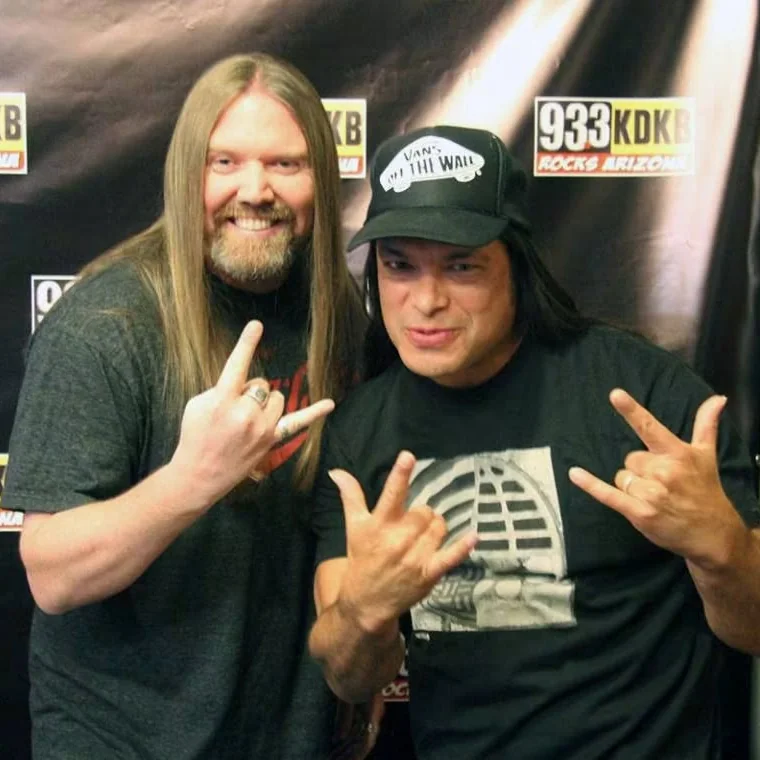
Bryan: Yeah. I'm glad I got the photo with you guys, because then I can say I knew him when he was in his 20s.
Gary: I know.
Bryan: I'm glad I got it, too. I can say I knew him when. So this is kind of a guitar nerd question, but what does he do naturally that took you forever to learn?
Gary: Well, it's like that with any family. I think he's version 2.0 of me. He's got all the osmosis of me, and listening to me, and having me teach him. But with Ian, I mean, he's already surpassed me with music theory. He does stuff with a complexity that I'd have to sit back and really go back at it again, because I'm set in my ways.
He'll come up to me and go, "Dad, I'm doing this thing. It's got a non-tertian interval." I'm like, "What interval? Can you tell me what that is?" And I'm asking my kid what it is.
And also the way he plays the blues, the way he phrases his vibrato, there's something about it that some of it I go, "Wow, man. I can't even do what he just did." And he doesn't just study me. He was really into John Mayer for a few years. He was super into John Mayer. He played nothing but John Mayer. My wife was about to kill him. And then he went into Stevie Ray heavily. And I think he learned some things that I didn't get to learn. So I notice things with his vibrato, his phrasing, that I just go, "I can't do that. I can't do that."
Bryan: So here's a really important question, too. Has he done something that's so good that you're like, "I'm stealing that"?
Gary: Absolutely, man. I'll tell you the truth. There's a bunch of times I said, "Ian, hold on a second. What did you just do? Show that to me." And he'll show me something. "Okay, I'm stealing that." Oh yeah, I've stolen some stuff off of him. Just licks, phrasing things he does.
And he plays great with his fingers, too. He's a great acoustic guitar player. He started doing these solo gigs where he does two hours at this local golf club. They have a pub. He goes down, he plays for two hours with just him and an acoustic and a looper. And I don't know if you've ever tried to do that, but to play acoustic all by yourself and keep the tempo going and sing, and then he'll loop and do solos, it's really phenomenal. He's a great acoustic player.
Bryan: Wow, that's crazy. Now, you guys are doing a record together, right?
Gary: Yes, we're in the middle of it now. We're recording an album, Like Father, Like Son.
Bryan: Well, that'll be cool. Any expected release date on that? '27, I'm assuming?
Gary: Yeah, '27. We plan to get it out next year. And it might be an instrumental record. We're kind of kicking around the idea of doing an instrumental record, just because I haven't done one in a long time. And to put the guitars right up front, and not have the vocals in there, and just have me and him shredding and trading solos and harmonizing, I thought might be a really cool release. And I have been in touch with Frontiers Records. I might do it through them, or I might do it solo. I'm not sure.
Bryan: Yeah. So, I know we talked about this a couple years ago. Is there still any truth to, any thoughts of, the Hoey Does Hendrix album?
Gary: Absolutely. I have absolutely put that at the top of the list, doing a Hendrix tribute, because tribute bands are big right now. Everybody's doing a tribute. And I was actually talking to the family the other day about it, and I was like, if I did a tribute band, who could I do? Who would I do that I could really play every night and put my soul behind it? And Hendrix would definitely be one I could see me doing. So yeah, that's still in the works.
And I also have an album idea that I'm working on called Hoey's Heroes. It's an album of covers and remakes of a lot of my favorite guitar players. It would be a mix of people like Jeff Beck to Hendrix to Stevie Ray and everything. And that would also have a lot of special guests playing on it, people that I think are heroes of mine, that I really admire and that I like as musicians. So Hoey's Heroes is coming, too.
Bryan: That's awesome. Well, as you signed on to the interview today, of course, I was listening to your version of "Rocky Mountain Way," which I absolutely love, because you just put this heaviness to that song. And I got tired of hearing the original song because I played it so much in radio. But your version is just so cool, man, because it's so much heavier, and I love it.
Gary: Thank you so much. Yeah, I added the heavy to that. And it's funny, because we just put out a record called Uncovered a little while back, which is just a digital record. Uncovered is basically a lot of the covers that I've done. We put a lot of them on a record that just came out digitally with Primary Wave, because Dave Kaplan sold his catalog to Primary Wave, which is a big company that's been buying everybody from Aretha Franklin to big names. So they have my catalog now, and they're kind of revamping some of the old stuff.
Bryan: Well, that's cool. So my only thing is this: if you do the Hoey Does Hendrix, please do "If 6 Was 9." That's my favorite Hendrix song ever.
Gary: Okay, you got it. I'll definitely do that. I promise.
Bryan: I'm holding you to it. It's on video now. I got it. Record comes out and it's not on there, I'm playing this clip. I'm going to send it to you.
Gary: You better.
Bryan: So I know we're getting long-winded here, but it has been amazing to have you on the show. So I want to just ask a few more questions, and then I'll let you go. What are some of the things on the road that are the biggest misconception that a fan has when you're in that touring band?
Gary: One of the misconceptions? Yeah. Well, I think number one is that it's easy. They think it's easy, and they think that it's all wine and roses. And I think what a lot of people don't understand sometimes is how hard the music business can be. The music is awesome; the business is hard.
And I think every musician, whether they want to admit it or not, we all have our ups and downs. We have our ups and downs, man. We have those days where... I'm on social media. I didn't grow up with social media, so it took me a long time to accept it and to embrace it. And so I go on a lot. I do a lot of posts about staying positive. I'm always posting things about appreciating what you have and just being positive, because there's so much negativity out there.
But the truth is, a lot of musicians, we all have dark days, man. We have days where we think our career is over. We think nobody cares anymore, or "I'm not having this happen like it used to." And so you're constantly having to grab your bootstraps and pull them up, and just go, you know what, just keep focused and keep doing what you do, and it'll all work out. And it always does. And I feel truly blessed to be able to have fed my family on rock and roll for the last 35 years.
But yeah, there's a side of the business that's kind of hard. The royalties, and the kind of money we used to make on record sales and airplay, and now it's streaming. I feel like sometimes musicians are always the last in line. If you get a movie gig, they spend everything on everything else, and then they go, "Oh, this is what we have left for the music budget." And it's always this tiny little thing. But you take that tiny little thing and you do your best with it.
And the thing I always tell musicians is, if you stay busy, you stay active, and you do things whether you're making money or not, even if you're helping somebody out for free or you're getting low money or no money, people want to hire a busy person. People want to work with somebody that's happening and they're doing all kinds of things. So my thing is, I always like to stay active. I'm always overwhelmed with how much stuff I'm trying to get done.
But I think that's the biggest misconception: the business is harder than it looks. Like AC/DC, "It's a long way to the top if you wanna rock 'n' roll." It's harder than it looks. It's right in the song. But at the same time, I feel truly blessed every day to wake up and be able to do whatever I want to do, because I am an independent artist and I can make my day whatever it is. So I'm very thankful and blessed for what I've been able to do.
Bryan: Have you ever done a show... and I would kind of like to target this a little bit more recent than the beginning of your career... has there been a show when a fan walked up to you and went, "You know what? You sucked tonight"? Because I know you get praise all the time. I know when you meet fans after the gig, everybody's like, "Dude, it was a great show. It was so much fun." This and that. But has anybody ever walked up to you and went, "You know what, dude? That sucked tonight"?
Gary: Well, not so much from a diehard fan, but sometimes people I really trust, or dear friends of mine from the East Coast that have no problem just telling it like it is. Nobody's said that directly, but the funny thing is, when you play a show sometimes...
I've had shows where I was struggling. Whatever it is, I'm too tired, or it's so humid my hands are sticking to the neck, and I'm trying to slide up the neck but it's kind of not happening. When you play an instrument, it's a physical thing. You've got tendons and you've got joints. And so some days, and you know this, you're a guitar player, some days it's just flowing. You're playing and you're feeling great. And then some days it's a struggle. You feel slow, and it feels like you're walking through quicksand.
And I've been surprised. The gigs where I thought, "Man, I killed it tonight. I killed it. I was so comfortable. Everything felt so great," that's the night when someone goes, "Yeah, you guys were okay tonight," or "You sounded a little off tonight." I'm like, "What?" And then the gigs where I felt like I was struggling and I did terrible, I would come off the stage and I'd be like, "Oh man, I don't know what was going on tonight. I apologize." And then they go, "Dude, that was one of the best shows I've ever seen you do." I'm like, "What?"
So in the struggle is sometimes where you're pulling it out, because if you're a pro, even on your worst day, you should still be pretty good. And I always joke with my friends that are talented. I always go, "Dude, I'm going to get you a t-shirt that says, 'Even when I suck, I'm better than you.'" You know what I mean?
So that kind of thing happens. You just have shows... Like, I just played in Mexico, and it dropped down to like 30-something degrees, and me and Nuno were playing, and we couldn't even feel our fingers, bro. I literally was touching the strings and they were like frozen cold ice, and there were licks I was struggling so hard to do, but I got through the gig. I made it through, but it was not easy. So yeah, but hopefully the fans won't tell me I suck anyway. Anyway.
Bryan: Well, I also use the term "I'm a guitar player" very, very loosely. But my thing is, I just love sitting down and playing along with songs. I still haven't been able to play along to a Gary Hoey song yet, because I'm not that good. But that's my thing. And I just enjoy the instrument, even just looking at it and everything. It's just such a cool thing.
Gary: Guitar nerd.
Bryan: I'm a total guitar nerd. And of course, you never have enough, right? Everybody's always like, "Dude, you've got enough guitars." I'm like, "Who says?"
Gary: That's right. That's right.
Bryan: So what still influences you today? Because you've been doing this a long time, and yet you're still coming up with new ideas. You're still doing different things. You're making different records. What influences you today to just keep going?
Gary: Well, paying the mortgage inspires me. Car payments, college tuitions. No. You know what? I just still love music, bro. I love music, and I'm always listening to music. If someone sends me something, I'll listen to it. The new Tony Iommi record, or the band the Pretty Reckless, or whatever it is. Rival Sons. I'm always just listening to things and getting inspired, hearing music, whether it's old-school blues or jazz or new metal, new rock. And I love seeing older artists like Tony, older people that are still doing it, that still put out the music.
And I have a catalog of ideas, bro. It's unbelievable. I have folders and folders and folders of song ideas.
Bryan: Wow.
Gary: Because what I do is, I record on this little recorder. It's made by Roland. It's called the Ederal. It's a little digital recorder where you can just drop ideas down. And I do stuff on my phone too, but with this thing, if I get an idea in the studio, I just hit record and bam, I put it down.
And then I keep putting lots and lots of ideas on it, and then I don't listen to any of it for weeks or months, because I find that while you're creating music, you're just letting it flow. Like you're an 18-year-old kid just rocking out in your bedroom.
And then if I go back a couple months later and listen to the ideas, I don't remember anything I played. And then when it comes back over the speakers, I go, "Wow, that idea is cool. That one's cliché. That one's eh." And then I drag them into these folders and I start cataloging them. And I just put "heavy riff," "metal riff," "acoustic ballad," "pop song," "something for Lita Ford." I make little names on them. And I have hundreds and hundreds, if not thousands, of ideas.
So music flows for me like it's an endless river. And when I pass away someday, my family knows where to go to get the archive. It's triple backed up, and hopefully Ian will dig through some of that and maybe record some of it one day.
But I never stop getting inspired, man. Every time I pick up the guitar. But a lot of times it's a sound. I'll put a certain thing on my Tone Master Pro, or a certain effect, and that will inspire me to write something differently. And that quest of chasing tones and different new sounds is what keeps me inspired.
Bryan: So what's the weirdest place that a riff or a melody ever came to your mind?
Gary: Wow, man. I don't know if this is weird, but sitting on the potty. I've written a few riffs in the john. Definitely, of course, driving down the street. I mean, everybody gets ideas when you're driving in the car. That's a big one. In church, a couple times I had a cool idea sitting there in church. But yeah, man, it could be anywhere and everywhere. But I think the bathroom is probably the weirdest one.
Bryan: All right, a couple other questions, man, and then I'll let you go. Okay, if you could go back and redo any of your albums today, would you do any of them differently, as far as either the sound or just how you did some of that stuff?
Gary: Yeah, I think every artist always feels like, when you try to finish a record, you want to just keep going. You want to just keep tweaking it, and it's never quite done. That's why we have producers, because producers say, "You're done." And now that we're in the digital world, it's even worse, because we can sit on our laptops and just keep polishing stuff till the cows come home. And back in the day, we had to go in the studio for seven days or 14 days, whatever the time frame was, and we had to get it done. So we had to perform.
But yeah, man, I always listen to... I don't know if it's albums or just songs. Sometimes a song will come on, I'm like, "Oh, man. I wish I could mix that a little differently. I wish the guitar was a little louder, or I wish the solo was this, or I wish the vocal was changed, or the drum sound." I always hear that. But I think probably my Monster Surf album is the one I'd want to go back and redo, if there was any one, 'cause I wasn't happy with the mastering on that one. So I could see me going back and redoing that one.
But the things I used to complain about, when the producer was going, "We're done, man. Your solo's good enough," I listen now and I go, "What was I thinking? What was wrong with me?" And I remember that now when I'm producing other people. I'll just say, "Listen, I know you really like this, but let's just try to beat it. If we don't beat it, that's still going to be there. Let's try another take."
And then I try to tell them that I'm here as a producer, I'm here to protect you, to sound the best you can to the world, because you're competing with everything that's out there on the radio. Or if someone says to me, "My sister really likes that part," and I know it isn't right for the song, I'll be like, "Listen, I know your sister loves it, but we're trying to sell records to the world, not your sister. You know what I mean? So we need to make a change. I'll cut that section out and I'll mail it to your sister."
Bryan: The term "guitar hero," I feel like, especially over the last probably 15, 20 years, has definitely kind of faded away. Maybe there's a little bit of a resurgence of that coming now. What do you think about that term? Do you think it's still a thing? Do you think there are guys coming up today, maybe even your son included, that are the next guitar hero, the next guy that we're going to be like, "Holy crap, that guy is just incredible to watch and to play"?
Because I don't know if you're like me, but sometimes I get lost in a YouTube rabbit hole just watching kids, even 8-, 10-year-old kids, just going to town on YouTube, and it kind of blows your mind. And of course, obviously, you've seen that with Ian. But what do you think about that term overall anymore?
Gary: Yeah, man, I think it's changed. It's changed dramatically. For me, the mystique of music is kind of gone. When we grew up, people were bigger than life. We used to sit and stare at the album covers and just look at what jewelry they were wearing, and "Oh, that tie is cool, and that jacket. Oh my god. And those boots." And we would look at the images of them, and then we would go to the show, and we might get there early and see the limousine pull up, and they'd go into the building. We'd be like, "Ah, my god."
And then we'd be in the crowd waiting, and we'd hear the rumble, and then the curtain would come down, and you'd see the silhouettes walking up on stage. We were so caught up in the mystique of it. And I feel like the guitar hero is just not there for me anymore.
To me, the true guitar heroes are the ones that had the looks, they had the sound, they had the mystique, they had the attitude, the personality. It was everything. And now you can go on Instagram, and within an hour you can hear five guitar players that sound like guitar heroes. They can play note for note, and they can do things that are mind-blowing.
I mean, I hear so many guys on the internet now that I literally go, "Wow, that kid, or that young man, is so phenomenal, and doing things that I can't do." I'm like, "I don't know what that kid's doing right now." This is just something at another level, and that part of it is awesome, because it keeps evolving.
But I think with the influx of AI, a lot of people I run into go, "Oh, go check out my new song on AI." And I heard them three months ago, they could barely play the guitar, and now they have a song on AI that's on YouTube that sounds like a finished record, and the singer sounds like he's in Survivor, and they call it their new single. And that gives me a little bit of an empty feeling, because AI is here to stay. People are going to use it, and I don't blame people for using it.
But I think the mystique of the guitar hero, for me, is not there anymore the way I grew up with it. So I don't know where the future's going. I think there will be guitar heroes, for sure, but they won't be the ones in the way that we grew up.
Bryan: Right. All right, man, last question, and we'll wrap things up. What do you hope that people remember most about you 20 or 30 years from now? Your legacy, I guess.
Gary: Yeah. For me, I want my legacy to be two things. I want it to be the music and the person. I want people to remember me by some of the music that I created, where they can say, "Wow, Gary's song 'Peace Pipe,' or Gary's song 'Dear Mama,' or 'Avalanche,'" or whatever it is, or any album, Burst Lounge. It could be whatever song: "That song really spoke to me," or "I played that song at my wedding," or "That song got me out of a hard time. That song helped me in my life when I really needed it." I hope that's part of my legacy, and that my music will live on long after I'm gone.
And then I hope that the person that I am is something that people remember. That when they met Gary, he was a cool guy, or he gave me some advice, or he helped me, and that I contributed to this world in a positive way.
Bryan: Awesome, man. Well, I couldn't agree with you more, in the fact that, dude, you're an awesome person. You've always been super nice when we've had the chance to hang out, and going to the shows and the whole thing. Man, I love going to see your concerts. I've talked about your shows a number of times on the podcast, and it's always a blast to see you.
I don't think I'm going to get to see you this time around on the Ho Ho Hoey, though, because I think you're across the state this time. You're like four or five hours away this time, so I don't know that I'll get a chance to see you this run. But it has always been such an honor and a privilege to call you a friend, and to have spent the last 30 years following your career and watching it, and now watching Ian. It's super cool, and I appreciate the fact that you would take the time out of your day today and sit down with me and answer some more questions.
Gary: Well, thank you, my brother. And I feel the same about you. We've been friends for a long time. I've always loved your energy, your attitude. You've always been a positive guy, and I definitely cherish our friendship. I was really looking forward to this today. I know we had a hard time getting it scheduled, but I literally was excited about talking to you today. So this has been an awesome hang with you, my friend.
Bryan: Thank you, man. And again, I'm glad we got to cover what we did. I could sit here another hour and talk to you about a ton more stuff in your career. So we'll save that for next year at some point. But we should mention to everybody that you should go to your website, garyhoey.com. You've got your tour dates up there, of course. Follow you on social media. I know you're very active on your Facebook and Instagram and all that stuff, so people should definitely follow you there. I know you've got the vinyl Ho Ho Hoey coming out, and you can get all the information at your website, which is awesome. So, man, thank you again for joining today. I greatly appreciate it.
Gary: My pleasure, my friend. I look forward to seeing you, and we'll do it again.
Bryan: Absolutely. So if I can get you to hang on the line just for one second, we'll wrap this up. But hey, everybody, thanks for joining us, and we'll see you on the next episode.
Gary: Rock and roll.
Tits McGee: Now, that was pretty entertaining. Great stories, great music, and somehow Bryan managed to get through an entire interview without buying another guitar. At least I think he did. If he didn't, I'll send Gary the bill. I'm Tits McGee. The bar is still open. See you next time.
Transcript adapted from the episode audio. Names and spelling corrected; filler words trimmed.
More Episodes
View All Episodes


Join the Regulars.
Rock stories, radio war stories, and the interviews I dug out of a guitar case full of cassettes. Get on the list and you'll hear about the good stuff first. No spam. No bullshit.
Unsubscribe anytime. No hard feelings. Mostly.